demo: eeglab sample dataset
A sample dataset from a visual experiment is released with EEGLAB software (Delorme & Making, 2004). We also include this dataset in our demo folder. Here we demonstrate how to apply all of the TF algorithms to real EEG data using this sample dataset.
First, we need to load the data using the EEGLAB pop_loadset() function:
EEG = pop_loadset( '/demo/eeglab_sample.set' );
Remove the two EOG channels:
EEG = pop_select( EEG, 'nochannel', {'EOG1','EOG2'});
Define our times and frequencies of interest:
foi=1:1:30;
toi=[-.5 1];
Now, mean-center the data, remove quadratic trends, and apply a cosine-square (Tukey) taper to the end 5% of the segments prior to TF decomposition:
EEG = nf_prepdata( EEG );
Calculate all of the different time-frequency transforms using default methods:
%First Class: Linear Decompositions
TF1 = nf_tftransform(EEG,'plt',0,'freqs',foi,'times',toi,...
  'method', 'stft');               %matlab spectrogram (STFT)
TF2 = nf_tftransform(EEG,'plt',0,'freqs',foi,'times',toi,...
  'method','filterhilbert');      %filter-Hilbert
TF3 = nf_tftransform(EEG,'plt',0,'freqs',foi,'times',toi,...
  'method', 'demodulation');        %complex demodulation
TF4 = nf_tftransform(EEG,'plt',0,'freqs',foi,'times',toi,...
  'method',  'wavelet');           %Morlet discretized wavelet
TF5 = nf_tftransform(EEG,'plt',0,'freqs',foi,'times',toi,...
  'method',  'cwt');                  %Continuous Wavelet Transform
TF6 = nf_tftransform(EEG,'plt',0,'freqs',foi,'times',toi,...
  'method',  'stransform');           %Stockwell Transform
%Second Class: Quadratic Distributions
TF7 = nf_tftransform(EEG,'plt',0,'freqs',foi,'times',toi,...
  'method',  'ridbinomial');        %Type-II Binomial RID
TF8 = nf_tftransform(EEG,'plt',0,'freqs',foi,'times',toi,...
  'method',  'ridbornjordan');      %Type-II Born-Jordan RID
TF9 = nf_tftransform(EEG,'plt',0,'freqs',foi,'times',toi,...
  'method',  'ridrihaczek');        %RID-Rihaczek TFD
Note that the nf_tftransform function can pass default arguments to each TF method.
Now, average each of the TF structures. Do not apply a baseline:
TFA1 = nf_avebase(TF1,'none');
TFA2 = nf_avebase(TF2,'none');
TFA3 = nf_avebase(TF3,'none');
TFA4 = nf_avebase(TF4,'none');
TFA5 = nf_avebase(TF5,'none');
TFA6 = nf_avebase(TF6,'none');
TFA7 = nf_avebase(TF7,'none');
TFA8 = nf_avebase(TF8,'none');
TFA9 = nf_avebase(TF9,'none');
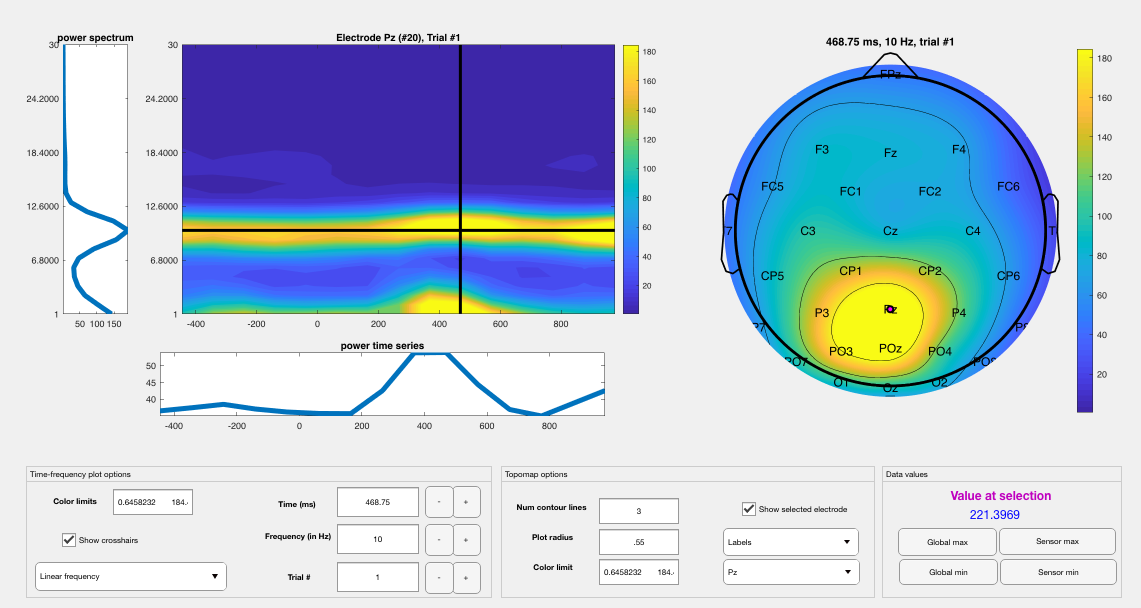
The individual outputs can be examined using the following as an example (for the STFT):
nf_viewerapp( TFA1 );
Which will produce the following: