nf_dcwt
The discretized continuous wavelet transform (DCWT) adapts the CWT for use with discrete frequency vectors. The DCWT reduces the computational demands of CWT. We use DCWT calculated according to Cohen (2014). DCWT is calculated using
TF = nf_dcwt( data, Fs, freqs, cycles, plt );
Where data is a 1/2/3D tensor of dimensions channels X time X trials, Fs is the sampling rate of the data in Hz, freqs is a vector of center frequencies for the wavelets, cycles is the number of cycles in each wavelet, and plt is 0 or 1 indicating whether or not the user would like a summary plot to be produced following transformation. Cycles can be specified as a single element (e.g. 3) in which case all wavelets will contain 3 cycles, or as a two-element vector (e.g. [3 8]) in which case the number of cycles will being at 3 at the lowest frequency and will linearly increase to 8 cycles at the highest frequency.
Defaults are: freqs = 1:1:Fs/2, cycles = [3 8], plt = 0. Data and Fs are required.
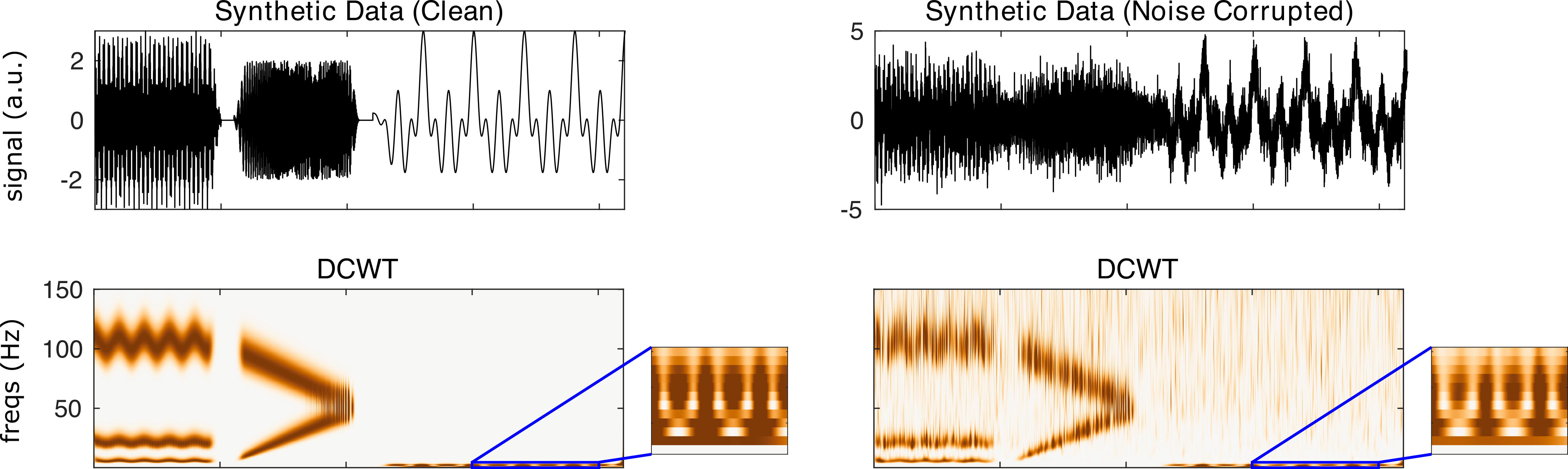
When DCWT is run on the demo synthetic data using
TF = nf_dcwt( data, 500 );
We obtain the following result:
References
Cohen, M. X. (2014). Analyzing neural time series data: theory and practice. MIT press.