nf_stft
The STFT (Gabor, 1946) functions by cutting data into windows of a specified length and with a specified percentage overlap. The data segments are then windowed and a discrete Fourier transform is computed on each data segment. The STFT is calculated using
TF = nf_stft( data, Fs, window, overlap, fRes, plt );
Where data is a 1/2/3D tensor of dimensions channels X time X trials, Fs is the sampling rate of the data in Hz, window is the length of the window in seconds, overlap is the percentage of overlap, fRes is the requested frequency resolution, and plt is 0 or 1 indicating whether or not the user would like a summary plot to be produced following transformation.
Defaults are: window = 0.5 s, overlap = 80%, fRes = 1 Hz, plt = 0. Data and Fs are required.
When STFT is run on the demo synthetic data with a brief 0.5 s window using
TF = nf_stft( data, 500, 0.5, 80 );
We obtain the ‘brief’ result, and when STFT is run on the demo synthetic data with a long 10 s time window using
TF = nf_stft( data, 500, 10, 95 );
We obtain the following:
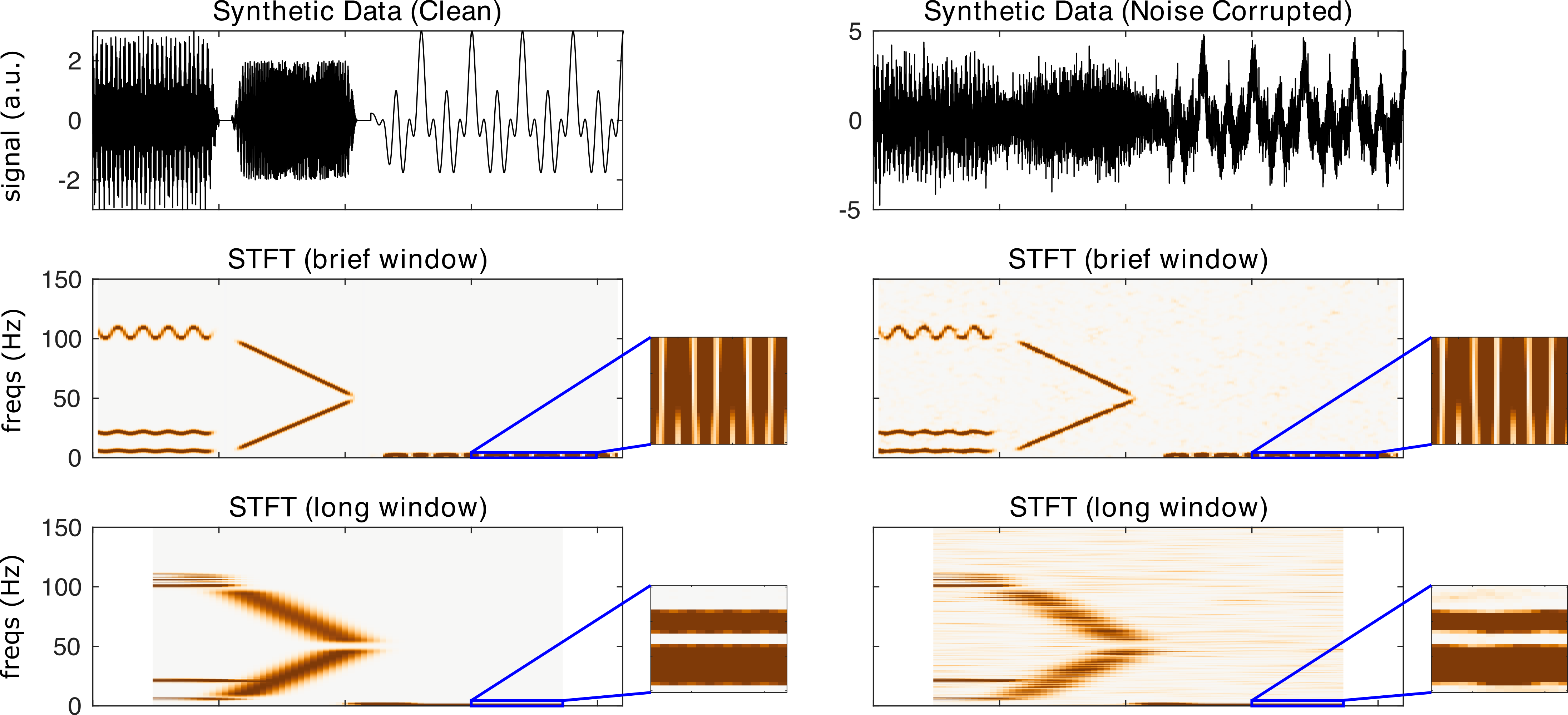
Note the time-frequency trade-off.
References
Gabor, D. (1946). Theory of communication. Part 1: The analysis of information. Journal of the Institution of Electrical Engineers-part III: radio and communication engineering, 93(26), 429-441.